
Measuring the Business Value of AI Agents: A Practical Framework
Building artificial intelligence (AI) agents is one thing, but measuring their actual return on investment (ROI) is another. In this guide, we break down a practical, math-driven framework to help enterprise leaders, developers, and FinOps professionals move past the AI hype and definitively quantify the value of their AI systems.
1. What Actually Counts as an "Agent"?
To measure the value of an agent, we first need a common understanding of what an AI agent actually is (0:41). When people refer to an agent, they are usually talking about one of three distinct technical structures (0:45):
- Workflows: Traditional software code that uses a Large Language Model (LLM) as a small step during its normal execution (0:53).
- Pipelines: A fixed series of sequential LLM or Retrieval-Augmented Generation (RAG) calls that always run in the exact same steps (1:02). This is by far the most common setup for enterprise chatbots (1:12).
- Agentic Systems: Dynamic systems equipped with a variety of tools (1:17). They evaluate context and make real-time decisions about what action to execute next (1:17).
Note: For the purpose of measuring business metrics, this framework applies equally to all three types (1:22).
2. Why Pricing an Agent is Phenomenally Complex
Calculating the "Cost" side of your ROI equation isn't as simple as checking an API pricing page (2:24). Large language models introduce severe pricing hidden fees and complexities (2:33):
- The Tokenizer Tax: Two different models might feature the exact same price per million tokens on paper, but use completely different tokenizers (2:52). For example, a newer model version might use 30% more tokens to process the exact same English sentence, quietly making it 30% more expensive (3:01).
- Hidden Re-billing via Chat History: When interacting with an agent, you do not just pay for your latest message (3:30). You resend the entire text and chat history back to the model with every single turn (3:37). If you upload a heavy image or document in your very first message, you are re-billed for that asset on every subsequent prompt (3:42).
- Multi-Model Overhead: The average enterprise AI agent relies on 3.5 different LLMs working together under the hood (4:44). This multi-model execution dynamically shifts request costs constantly (4:40).
3. The 3-Step Business Value Framework
To unlock true quantification, your organization should follow a structured three-step process (1:45):
Step 1: Split the Problem into Tangible Use Cases
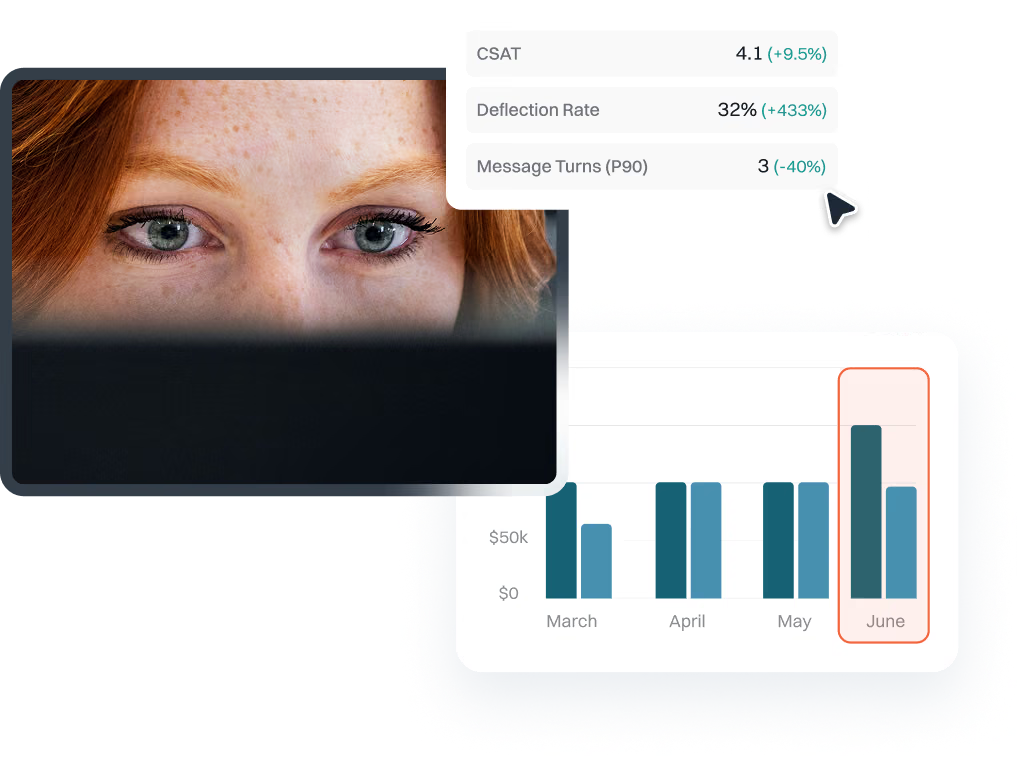
Do not categorize systems by technology names like "Copilot" (5:49). Group them by the specific enterprise use case they address (e.g., customer support, automated marketing, document extraction) (5:38). Every use case must have tangible outcomes and measurable objectives (5:55).
Step 2: Track Quantifiable KPIs
ROI is a lagging metric (6:08). To calculate it, you must track real-time indicators that fall into four specific data buckets (6:38):
- Booleans: Simple True/False flags (6:42).
- Percentages: Customer satisfaction rates or success thresholds (6:48).
- Numbers: Raw processing quantities (e.g., tickets handled) (6:59).
- Likert Scales: User-facing rating systems (e.g., 1-to-5 star feedback) (6:59).
Step 3: Apply the Value Formulas
Once you map your use cases and KPIs, utilize these three core metrics to evaluate true business impact (1:56):
Formula 1: Financial Value
$$\text{ROI} = \frac{\text{Net Profit (Savings or Net New Revenue)}}{\text{Total Complexity Cost}}$$ Your business logic and KPIs define your financial return, which must outweigh the compounding hidden costs of your token execution (7:40).
Formula 2: Time Savings
$$\text{Time Saved} = (S \times H) - A$$
- S (Success Indicator): Blended variable equal to 1 if the agent successfully completed the task, and 0 if it failed (8:00).
- H: The standard amount of time it takes a human to manually do the job (8:06).
- A: The execution latency and processing time utilized by the AI agent itself (8:15).
This reveals if a "successful" agent is actually a net negative because it demands too much human review time to catch hallucinations (8:34).
Formula 3: The Productivity Threshold
An AI agent officially improves organizational productivity only if it satisfies this specific probability rule (8:57):
$$P(\text{Success}) > \frac{\text{Time to Verify}}{\text{Time to Do}}$$
- Low Verification Burden: If a task is incredibly difficult for a human to perform from scratch, but takes only two seconds to verify as correct, the agent does not need a perfect accuracy rate to deliver massive productivity gains (9:24).
- High Verification Burden: If verifying the agent's work takes the exact same amount of time as doing it manually, your agent yields zero productivity impact (9:34).
- Negative Impact Exception: If an agent errors on a high-stakes task—like telling a user they won a free vacation—unwinding that mistake takes significantly longer than standard human execution time (9:53). This tanks your operational efficiency (10:02).
If you'd like to customize this further for your website, let me know:
- Do you want this formatted into specific Webflow rich-text classes or code blocks?
- Would you like an accompanying TL;DR key takeaway summary to put at the top of the blog?
- Do you want to generate a lead-generation call to action (CTA) for the end of the post?